
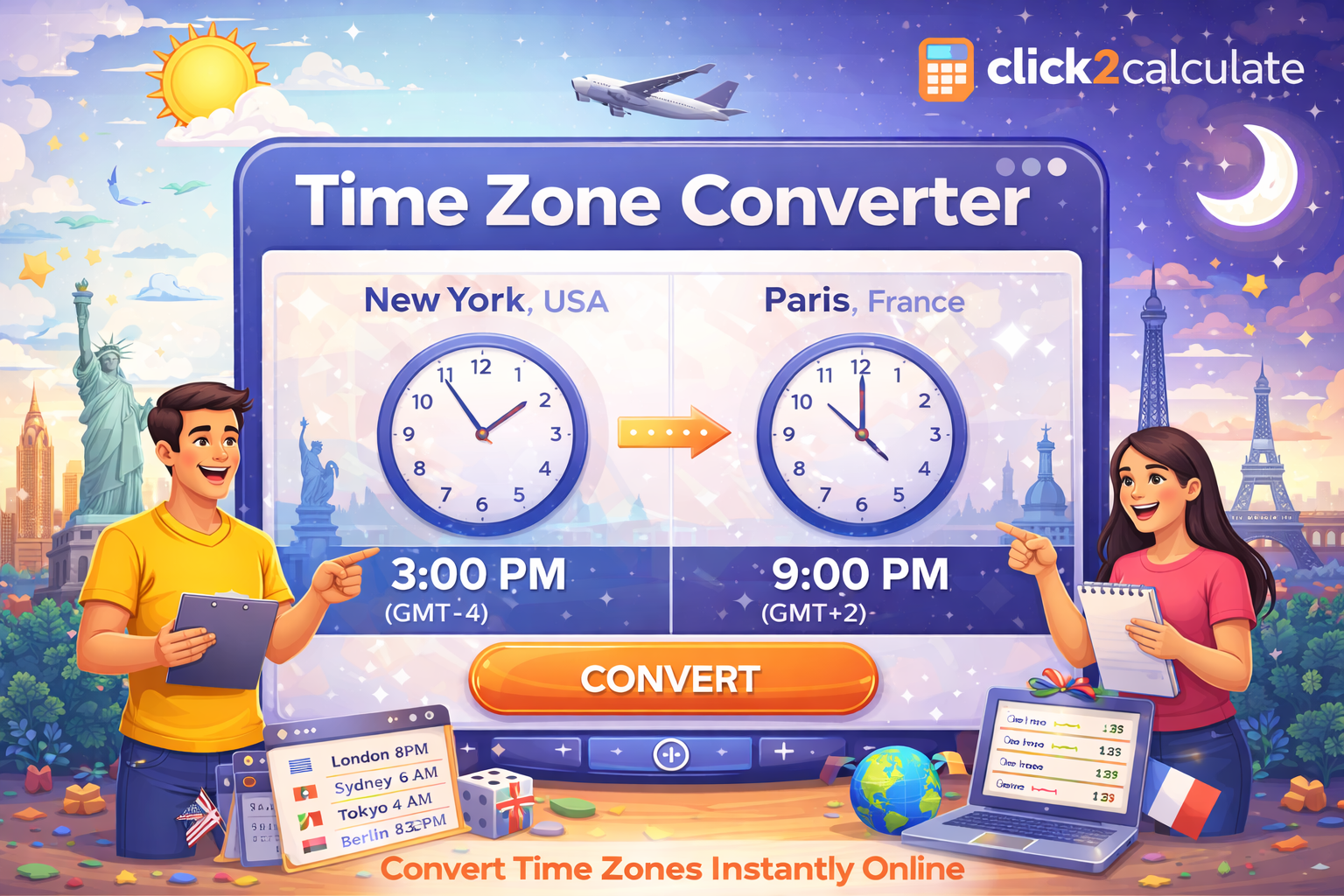
Looking for a reliable time zone converter? Coordinating across borders can be a challenge, but our tool allows you to convert time zones online with a single click. Whether you are acting as a global meeting planner or just checking a friend’s local time, we provide instant accuracy.
Table of Contents
ToggleTrying to coordinate a project update between New York, Mumbai, and London can quickly turn into a headache. One wrong calculation and you are either waking up a client at 3:00 AM or sitting alone in an empty virtual meeting room.
In our hyper-connected world, manual time math is a risk you don’t need to take. A reliable Time Zone Converter is the ultimate shortcut to seamless global collaboration, stress-free travel planning, and foolproof scheduling.
What is a Time Zone Converter?
A Time Zone Converter is a dynamic digital tool designed to instantly translate the local time of one geographic region into another. Instead of searching for current offsets or guessing which country is currently observing daylight saving modifications, you simply input a date and time to get an immediate, error-free conversion.
Whether you need to sync with a remote team or catch an international live stream, our free tool supports all major global standards, including:
-
- UTC & GMT (Coordinated Universal Time / Greenwich Mean Time)
-
- IST (India Standard Time)
-
- EST & EDT (Eastern Standard / Daylight Time)
-
- PST & PDT (Pacific Standard / Daylight Time)
-
- CST, MST, BST, JST, AEDT, and hundreds more.
Smart Ways a Time Zone Calculator Saves Your Day
Operating across borders requires precision. People around the globe rely on instant time conversion for a variety of critical daily tasks:
-
- Flawless Business Scheduling: Secure international client meetings without the back-and-forth “What time works for you?” emails.
-
- Remote Team Alignment: Coordinate virtual daily stand-ups for distributed workforces spanning multiple continents.
-
- Smooth Travel Itineraries: Keep track of flight departures, arrivals, and hotel check-ins across multiple layovers.
-
- Miss-Proof Virtual Events: Instantly convert global webinar, gaming tournament, or product launch schedules to your local time.
-
- Market Tracking: Monitor international stock exchange opening hours (like the NYSE, London SE, or Tokyo SE) in real-time.
How Does Time Zone Conversion Actually Work?
The global time system is structured around Coordinated Universal Time (UTC). Every region on Earth sets its local clock based on a specific positive (+) or negative (-) offset from this baseline standard.
The formula for converting time is straightforward, though keeping track of it manually is where errors happen:
Local\ Time = UTC \pm Offset
Here is how some of the world’s most active economic hubs align with the baseline:
| Time Zone | Full Name | Standard UTC Offset |
| UTC / GMT | Coordinated Universal Time | UTC \pm 0 |
| IST | India Standard Time | UTC + 5:30 |
| JST | Japan Standard Time | UTC + 9:00 |
| AEST | Australian Eastern Standard Time | UTC + 10:00 |
| EST | Eastern Standard Time (North America) | UTC – 5:00 |
| PST | Pacific Standard Time (North America) | UTC – 8:00 |
Our automated converter handles these calculations in the background instantly, factoring in complex geographical borders so you don’t have to.
Most Popular Time Conversions You Need to Know
If you frequently handle international business, chances are you encounter these specific corridors daily:
1. UTC to IST
-
- The Rule: Add 5 hours and 30 minutes to the UTC time.
-
- Example: If a global server update happens at 12:00 PM UTC, it will be 5:30 PM IST.
2. IST to EST
-
- The Rule: During standard winter months, Eastern Standard Time is 10 hours and 30 minutes behind India.
-
- Example: An evening sync at 8:00 PM IST translates to a morning start of 9:30 AM EST.
3. PST to IST
-
- The Rule: Silicon Valley time (Pacific Standard) is 13 hours and 30 minutes behind India.
-
- Example: A morning pitch at 10:00 AM PST means your team in India will tune in at 11:30 PM IST.
4. GMT to IST
-
- The Rule: Greenwich Mean Time sits at the base offset, making it 5 hours and 30 minutes behind India.
-
- Example: A UK morning broadcast at 6:00 AM GMT airs at 11:30 AM IST.
5. EST to IST
The Rule: EST to IST Conversion
EST (Eastern Standard Time) is UTC -5:00
IST (India Standard Time) is UTC +5:30
Time Difference: IST is 10 hours 30 minutes ahead of EST.
Example:
9:00 AM EST = 7:30 PM IST
5:00 PM EST = 3:30 AM IST (next day)
11:00 PM EST = 9:30 AM IST (next day)
Features of Our Free Time Conversion Tool
Why bookmark our specific converter? We built it to solve the exact pain points professionals face every day:
-
- Zero-Lag Accuracy: Instant calculations as you type, giving you immediate clarity.
-
- Automatic Daylight Saving (DST) Tracking: The tool automatically detects if a region has jumped forward or fallen back an hour, preventing seasonal scheduling mistakes.
-
- Completely Mobile Optimized: Plan on the go. Our clean, responsive layout works perfectly on smartphones, tablets, and desktops.
-
- 100% Free & Unrestricted: No paywalls, no forced registrations, and no limits on how many cities you can compare.
5 Pro-Tips for Cross-Border Scheduling
-
- Watch the DST Transitions: Remember that countries change their clocks on different weekends in the Spring and Autumn. Always use a dynamic calculator during these transition weeks.
-
- Establish a “Core” Company Time: For global teams, pick a central baseline reference (like UTC) for all shared calendar invites.
-
- Find the “Golden Window”: Look for overlapping working hours. For example, the afternoon in the UK cleanly overlaps with the morning in the US and the evening in India.
-
- Send Multi-Zone Invites: When emailing a client, always state the time in their local zone first, followed by yours.
-
- Confirm the Date Line: If you are scheduling a late-night meeting across the Pacific, double-check whether your counterpart will be joining on the same calendar day or the next.
Frequently Asked Questions
What is the difference between UTC and GMT?
For everyday scheduling, UTC and GMT are essentially identical. However, UTC is a highly precise, modern scientific standard used by global networks, while GMT is a traditional timezone historically tied to the United Kingdom.
Does this tool automatically adjust for Daylight Saving Time?
Yes. The converter continuously updates its database to reflect real-time changes in regional daylight saving laws, ensuring your conversions are accurate regardless of the season.
Does India use multiple time zones?
No. Despite its massive geographic expanse, the entire country of India observes a single uniform time standard—India Standard Time (IST)—which stays at $UTC + 5:30$ all year long.
Why do some time zones include half-hour splits?
While most regions choose whole-hour offsets from UTC, a few countries (like India, Iran, and parts of Australia) adopted 30-minute or 45-minute offsets to align their clocks more accurately with the actual position of the sun over their territory.
Boost Your Productivity with More Time Tools
Looking for more ways to optimize your global calendar? Check out our suite of specialized time utilities:
-
- World Clock Dashboard: View the current time in your top 5 favorite global cities at a glance.
-
- Global Meeting Planner: Find the perfect overlapping business hours between 3 or more countries.
-
- Date Duration Calculator: Calculate the exact number of days, weeks, or business days between two dates for project milestones.
Streamline Your Global Calendar Today
Don’t let time differences slow down your momentum. Bookmark our Time Zone Converter right now to guarantee that you, your clients, and your global partners stay perfectly in sync, every single time.
FAQs:
1. What is a time zone converter?
A time zone converter is a tool that converts a date and time from one time zone to another. It helps users accurately schedule meetings, calls, events, and travel across different regions.
2. How do I convert one time zone to another?
Select the source time zone, enter the date and time, then choose the target time zone. The converter automatically calculates the equivalent local time.
3. What is IST?
IST (Indian Standard Time) is India’s official time zone and operates at UTC+5:30 throughout the year.
4. How do I convert IST to EST?
During standard time, EST is 10 hours 30 minutes behind IST. During US daylight saving time, EDT is 9 hours 30 minutes behind IST.
5. What is the difference between UTC and GMT?
UTC (Coordinated Universal Time) is the global time standard used worldwide. GMT (Greenwich Mean Time) is a time zone based on the prime meridian. For most practical purposes, they are treated as the same time.
6. What is Daylight Saving Time (DST)?
Daylight Saving Time is the practice of moving clocks forward by one hour during part of the year to extend evening daylight. Many countries use DST, while others, including India, do not.
7. Does India observe Daylight Saving Time?
No. India follows Indian Standard Time (IST) all year and does not observe Daylight Saving Time.
8. Why does my time conversion change during the year?
Many countries adjust their clocks for Daylight Saving Time. This changes the time difference between regions throughout the year.
9. What does UTC stand for?
UTC stands for Coordinated Universal Time, the primary time standard used worldwide.
10. How many time zones are there in the world?
There are more than 24 official time zones worldwide because some regions use half-hour and quarter-hour offsets.
11. What is the best time to schedule a meeting between India and the USA?
The best overlap is typically between 6:30 PM–10:30 PM IST and 9:00 AM–1:00 PM Eastern Time, depending on DST.
12. How do I convert EST to IST?
Add 10 hours 30 minutes during standard time. During daylight saving time, add 9 hours 30 minutes.
13. What is the difference between EST and EDT?
EST (Eastern Standard Time) is UTC−5, while EDT (Eastern Daylight Time) is UTC−4 during daylight saving months.
14. What is the difference between PST and PDT?
PST (Pacific Standard Time) is UTC−8, while PDT (Pacific Daylight Time) is UTC−7 during daylight saving periods.
15. Can I convert future dates and times?
Yes. A good time zone converter calculates future dates while accounting for upcoming DST changes and timezone rules.
16. Why is time zone conversion important for remote teams?
It helps team members schedule meetings, deadlines, webinars, and calls without confusion or missed appointments.
17. Which countries use UTC?
UTC itself is primarily a reference standard, but several countries and territories operate on UTC year-round.
18. How do I convert UTC to local time?
Select UTC as the source time zone and choose your local city or time zone as the destination. The converter will display the equivalent local time.
19. What are the most commonly used time zones?
Some of the most searched time zones include:
UTC
GMT
IST
EST
CST
MST
PST
CET
JST
AEST
20. Why should I use a time zone converter instead of calculating manually?
Manual calculations can lead to mistakes, especially when daylight saving changes, date shifts, and half-hour offsets are involved. A converter ensures accuracy.
21. How do I convert UK time to IST?
During winter (GMT), IST is 5 hours 30 minutes ahead. During summer (BST), IST is 4 hours 30 minutes ahead.
22. How do I convert PST to IST?
PST is generally 13 hours 30 minutes behind IST. During daylight saving time (PDT), the difference becomes 12 hours 30 minutes.
23. Why do some time zones have 30-minute offsets?
Countries such as India, Iran, Afghanistan, and parts of Australia use half-hour offsets to better align local time with their geographic location.
24. What is the International Date Line?
The International Date Line is an imaginary line near the Pacific Ocean where the calendar date changes by one day when crossed.
25. Can a time zone converter help with international travel?
Yes. Travelers can quickly compare departure and arrival times, avoid confusion, and plan itineraries across different countries.
26. What is the easiest way to compare multiple time zones?
Use a multi-time-zone converter or world clock dashboard that displays several cities simultaneously.
27. Why do some countries have multiple time zones?
Large countries such as the United States, Canada, Russia, and Australia span vast geographic areas, requiring multiple time zones.
28. What is the difference between local time and UTC?
Local time is the time observed in a specific region, while UTC is the universal reference standard from which local offsets are calculated.
29. How can I avoid scheduling mistakes across time zones?
Always use a reliable time zone converter, confirm the meeting date, and check whether daylight saving time applies in either location.
30. What is the most accurate way to convert time zones online?
Use a converter that relies on the IANA Time Zone Database and automatically updates for daylight saving changes and regional timezone rules.